

Research Center for Chemical and Materials Informatics
Molecular and Materials Function Informatics Integrating Experiments, Computations, and AI
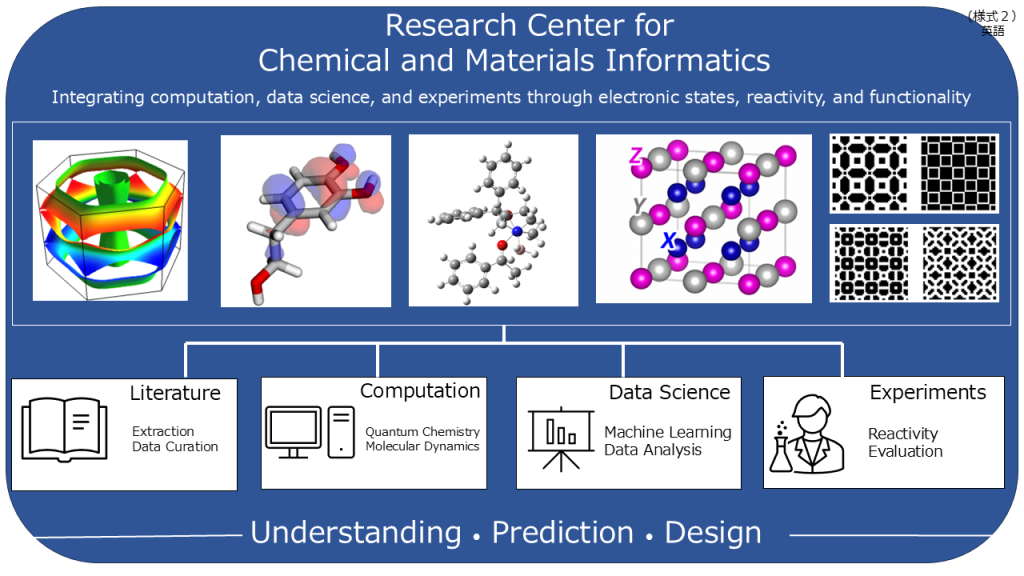
This research center aims to build a new research infrastructure for understanding, predicting, and designing functions—from molecules to materials—by integrating experimental chemistry, quantum chemical calculations, first-principles calculations, machine learning, and the analysis of materials measurement data across the fields of chemistry, materials science, physics, and information science. The center is named the “Chemistry and Materials Informatics Research Center” and aims to elucidate the principles underlying functional behavior common to chemistry and materials science by linking molecular reactivity, the electronic states of materials, and experimental, measurement, and computational data.
Currently, in chemistry and materials science, there is a growing need to efficiently explore and design high-performance molecules and materials to address societal challenges in fields such as healthcare, the environment, energy, and electronics. However, because molecular reactivity, material properties, electronic states, experimental measurements, literature information, and machine learning have each developed as separate fields, a common foundation that consistently links molecular-level structures and reactivity with functional expression at the materials level has not been sufficiently established.
The academic significance of this research center lies in its approach to integrating experiments, computations, and data science by treating “electronic states,” “reactivity,” and “functional expression” as common concepts, rather than treating molecules and materials as separate entities. In particular, by combining a small number of high-quality experimental data with theoretical information derived from quantum chemical calculations and first-principles calculations, we aim not only to improve predictive accuracy but also to extract the factors governing functionality in an explainable manner.
The social significance of this research lies in its ability to accelerate the discovery of a wide range of functional molecules and materials, including antioxidant molecules, metal chelating molecules, photofunctional molecules, energy conversion materials, and electronic functional materials. Through this, we aim to deepen our understanding of chemical and materials phenomena as part of basic research, while also fostering an on-campus research network that will lead to future industry-academia collaborations, the acquisition of large-scale external funding, and international joint research.
-
Faculty of Engineering
-
Faculty of Engineering
-
Faculty of Engineering